Home Work About Contact

Seen

A film and TV tracker where your recommendations come from friends, not an algorithm.

Designer and developer iOS and Android Live on the App Store and Google Play

Problem

Friends are the main way people find something to watch, but their recommendations get lost in group chats and notes apps.

What I did

I interviewed 5 people and surveyed 54, then designed and built an app that keeps every recommendation, with who sent it and why. I did the product, design, development and marketing myself.

Outcome

Live on iOS and Android. By 7 August 2026, 109 users had sent 327 recommendations, and 61% had at least one friend on the app.

Get a rec from a friend, see why they sent it, and send it on.

Recommendations get lost.

Picking something to watch means scrolling for ages, and algorithm suggestions and strangers’ reviews don’t know your taste. Recommendations from friends do, but they end up in group chats and notes apps. By the time you sit down to watch, you’ve forgotten what they were or who suggested them.

Existing apps don’t fix this. Letterboxd is built around public reviews and following strangers, and covers films only. TV trackers like TV Time and Serializd track shows, but don’t put friends’ recommendations at the centre. And most people don’t use any app at all.

Illustration.

5 interviews, 54 survey responses.

Between January and March 2025 I interviewed 5 people, mostly people who don’t track what they watch, plus one Letterboxd user. I asked 7 questions, from how they keep track today to what makes them actually watch something a friend recommends. The survey got 54 responses.

What I found

  1. 01

    87%

    use memory, notes or nothing. Only 9% use an app. Four of the five people I interviewed had never used one.

    Most people don’t track what they watch, and most don’t know tracking apps exist.

    “I didn’t think that there was a tracking app.”
  2. 02

    74%

    Friend recommendations were the top source.

    Friends are the main way people find what to watch, but who’s recommending matters.

    “If there’s any input from someone I trust it makes an impact.”
  3. 03
    “Sometimes I have a long list and forget who told me about it. It’s just a random list of titles that don’t mean much.”

    Friends’ recommendations get lost.

  4. 04
    “Chronic scroller. Jump from every TV app for 2 hours unless I have something recommended.”

    Picking something means endless scrolling.

  5. 05

    61%

    would join if a friend invited them.

    People would join if their friends were there. That’s also the biggest risk.

    “If a few of my friends used it first and I trusted their taste.”
    “Don’t know many people who use anything else, so it doesn’t feel like I need to do it.”

One result surprised me. Seeing what friends are watching (30%) and episode discussion (24%) rated lowest of the 7 features I asked about, while personalised recommendations rated highest (67%).

Design decisions, screen by screen.

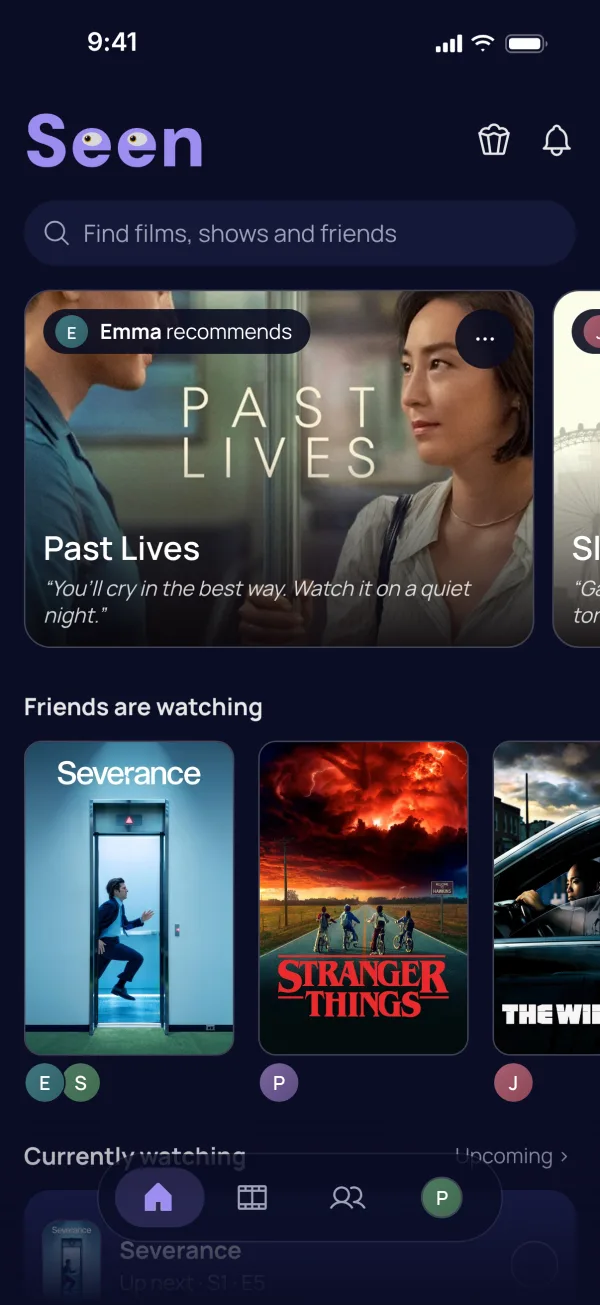
Seen Home: a recommendation from Emma for Past Lives with her note, then a Friends are watching row of posters, with the tab bar at the bottom.
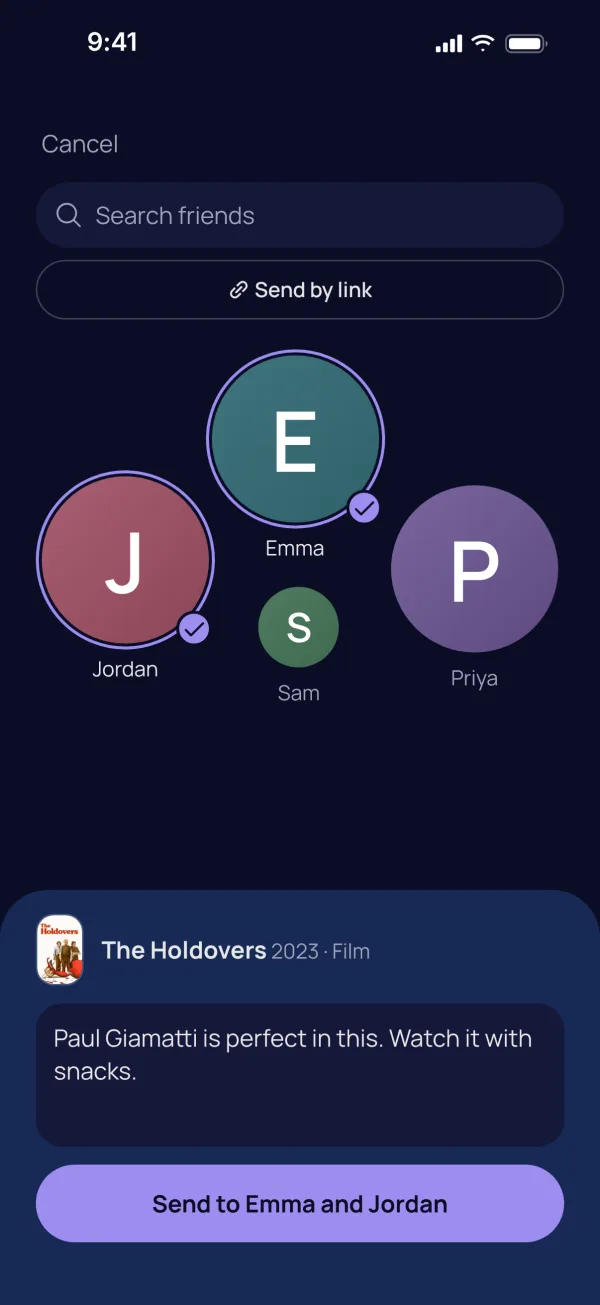
Seen Recommend sheet: friends shown as circles with Emma and Jordan picked, a typed note about The Holdovers, and a Send to Emma and Jordan button.
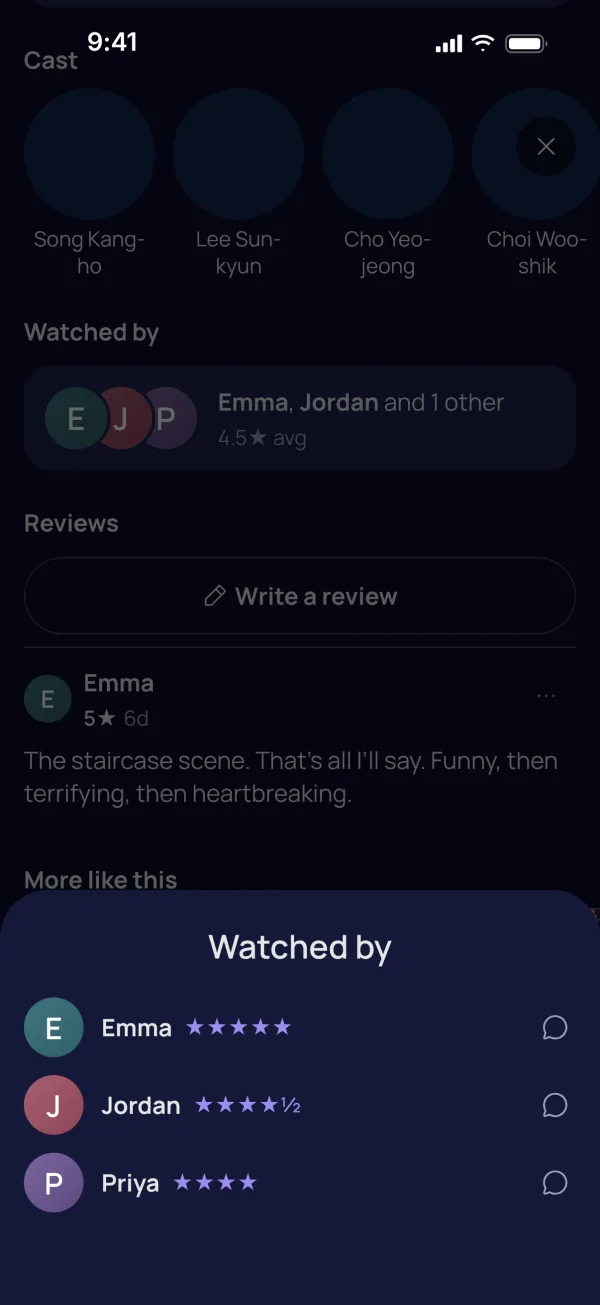
Seen title page with a Watched by sheet open, listing star ratings from Emma, Jordan and Priya.
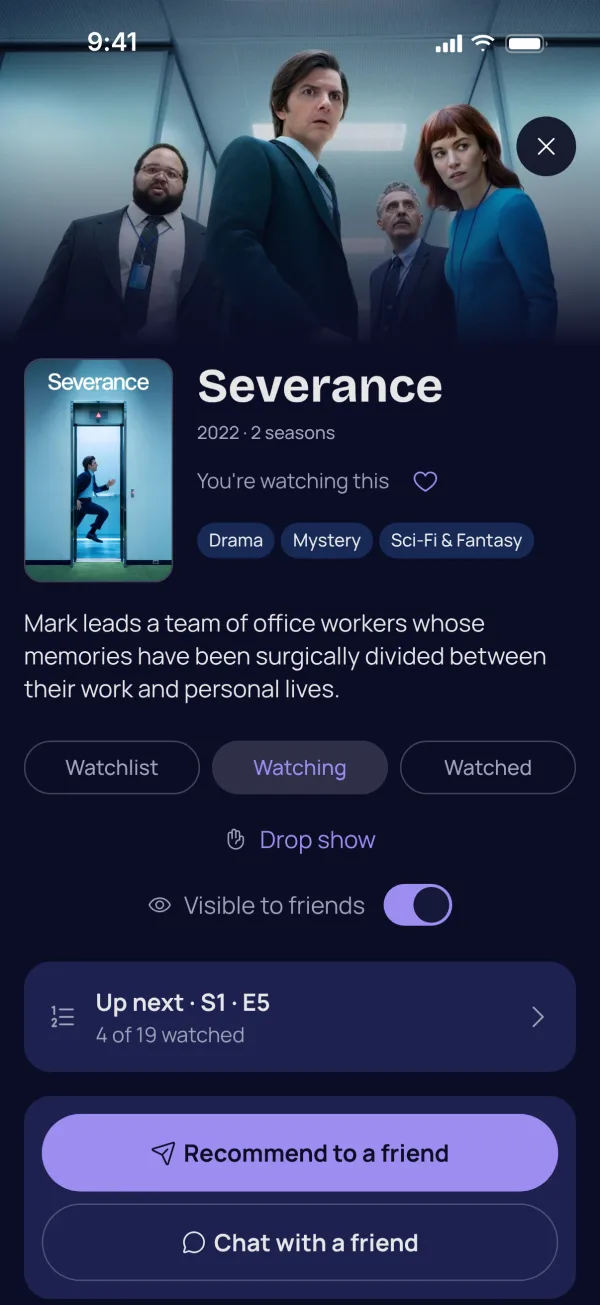
Seen show page for Severance: Watchlist, Watching and Watched buttons, a Visible to friends switch, and Up next, season 1 episode 5, 4 of 19 watched.
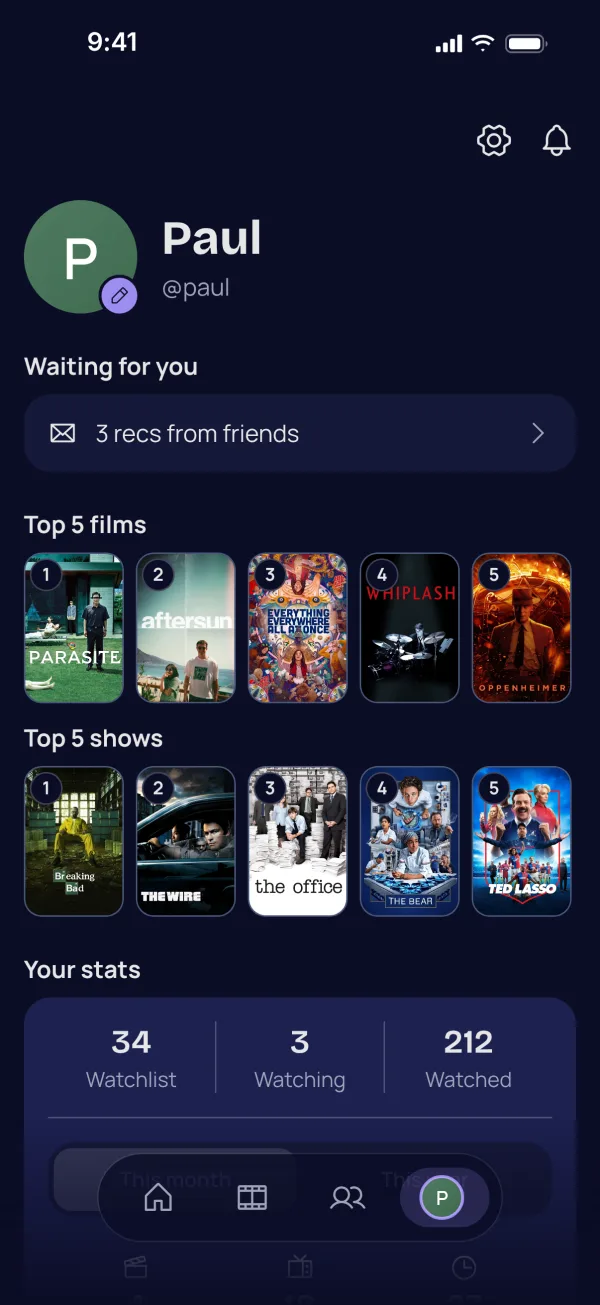
Seen profile: Top 5 films, Top 5 shows and stats showing 34 on the watchlist, 3 watching and 212 watched.
Seen Home: a recommendation from Emma for Past Lives with her note, then a Friends are watching row of posters, with the tab bar at the bottom.
  1. Decision
    A recommendation is its own thing.
    Why
    It keeps the note and who sent it, so you always know who recommended what and why.
    Seen Home: a recommendation from Emma for Past Lives with her note, then a Friends are watching row of posters, with the tab bar at the bottom.
    1. The note comes with the rec: who recommended it and why, not an algorithm.
    2. Lower down on purpose. Seeing what friends watch rated lowest in the survey (30%).
  2. Decision
    Recommending is the main action.
    Why
    Friends are the main way people find something to watch (74%).
    Seen Recommend sheet: friends shown as circles with Emma and Jordan picked, a typed note about The Holdovers, and a Send to Emma and Jordan button.
    1. Works for friends who aren’t on Seen yet.
    2. Picking people is the point, so friends are big and tappable.
    3. The why that gets lost in group chats.
  3. Decision
    Friends, not strangers.
    Why
    “Having anyone seeing that would be weird.” No public feeds. Two limited exceptions came later, both placed below friends: public episode comments and labelled reviews from TMDB.
    Seen title page with a Watched by sheet open, listing star ratings from Emma, Jordan and Priya.
    1. Ratings from friends, not strangers.
  4. Decision
    Make tracking worth doing.
    Why
    Most people don’t track at all, so logging has to be quick. Episode comments stay hidden until you’ve ticked off that episode, because 52% rated avoiding spoilers 4 or 5 out of 5, and spoiler reviews are covered until tapped.
    Seen show page for Severance: Watchlist, Watching and Watched buttons, a Visible to friends switch, and Up next, season 1 episode 5, 4 of 19 watched.
    1. Friends-only by default.
    2. One tap to tick off an episode.
    3. The main button on every title.
  5. Decision
    Reward logging, not volume.
    Why
    Top 5 and stats make logging worth it. No badges or points.
    Seen profile: Top 5 films, Top 5 shows and stats showing 34 on the watchlist, 3 watching and 212 watched.
    1. Recs you haven’t watched yet.
    2. Your Top 5 films and shows.
  6. Decision
    Keep it simple.
    Why
    Letterboxd “looked too complicated”. Seen has a few main tabs and friends first on every screen.
    Seen Home: a recommendation from Emma for Past Lives with her note, then a Friends are watching row of posters, with the tab bar at the bottom.
    1. Four tabs.

Screens show sample data.

Decision
Pick something together.
Why
Choosing something to watch shouldn’t take 45 minutes. Tonight lets two people swipe the same cards until they both say yes.

After launch, people weren’t adding friends.

Seen is much better with friends on it. After launch I noticed people were signing up without adding any. In mid July only 50% of users had a friend on the app. The research had called this the biggest risk.

  • 50%

    of users had at least one friend on the app in mid July.

  • 0 of 28

    recommendation links sent to people without the app led to a sign-up.

  • Invite links lost

    Invite links were lost during install, so the friendship never formed.

  • Empty Home

    The Home empty state never prompted anyone to send a recommendation.

Every step of getting a friend on the app

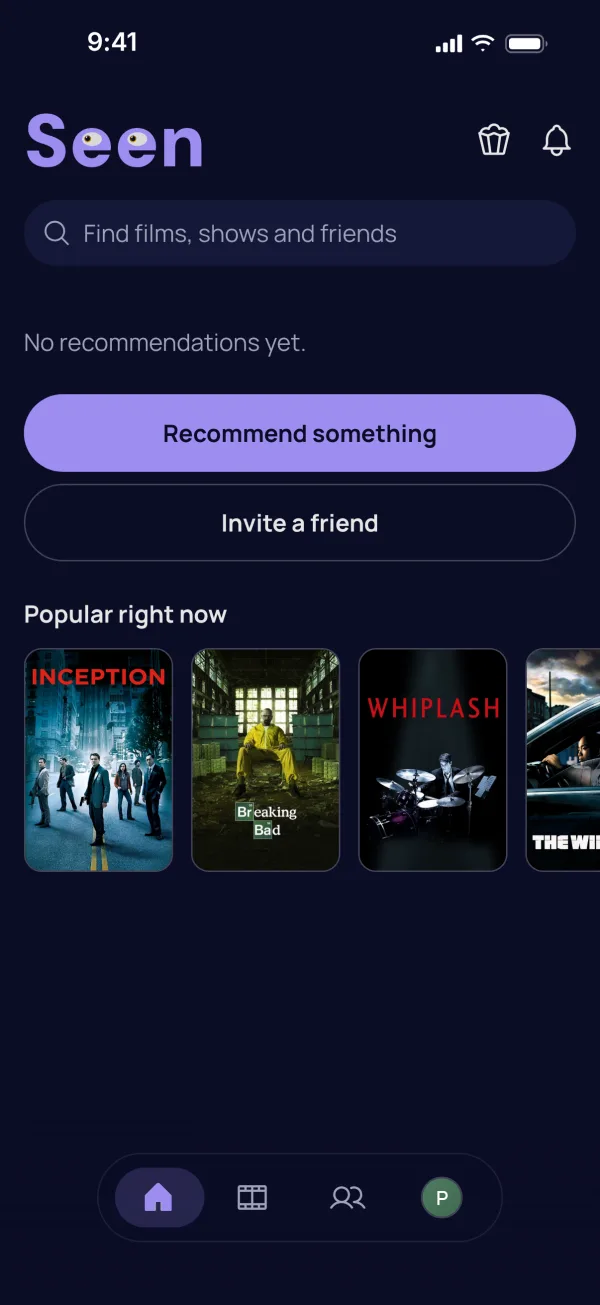
Seen Home with no recommendations yet. It offers a Recommend something button, an Invite a friend button and a Popular right now row of posters.
A new account’s Home: one line, two actions and something to browse.
  1. A friend sends a rec link

    It works for someone not on Seen yet. I fixed these links on 14 October 2026.

  2. The invite survives the install

    Fixed, so the friendship forms after the App Store.

  3. Sign-up asks for a first rec

    Onboarding has a “send your first rec” step.

  4. Import your history

    Letterboxd, IMDb, TV Time or a pasted list.

  5. Home asks too

    Rebuilt: “Recommend something”, “Invite a friend” and “Popular right now”.

Useful on your own too: Up next, new-episode alerts, where to watch, and More like this.

Cut as too pushy: an onboarding step asking new users to pick 3 people.

Other changes from feedback.

I test every change on a development build on two phones, an iPhone and a Samsung Galaxy A16, before it ships. These changes came from feedback, data or testing:

  • 3 days

    A friend suggested the watchlist overlap prompt on WhatsApp, and it was live three days later: add a title to your watchlist and Seen tells you which friends have seen it, then opens a chat with them.

  • 1.03:1

    Recreated.

    The Google sign-in button was dark on navy, with a contrast of 1.03:1. Changed to white.

  • Added because users asked

    A “Dropped” status, list pasting, and “More like this”.

Results so far.

  • 109

    users

    7 Aug 2026. 106 finished onboarding.

  • 61%

    with at least one friend

    66 users, up from 50% three weeks earlier.

  • 327

    recs sent

    59 marked watched.

  • 198

    onboarded

    Early October 2026.

Both videos on this page were made for Seen’s TikTok. Posts like these got views, but replying to people on X and Reddit brought more sign-ups.

The research was right about the biggest risk. Users with friends behaved completely differently from users without, and most users never got past an empty library: in August, 83% had 5 or fewer titles. Importing history and fixing recommendation links mattered more than new features.

What I learned.

  • Getting people to send recommendations is easier than getting the person who receives one to watch it.

  • What people rate highly in a survey isn’t always what brings users.

    Episode discussion rated lowest, but people leaving TV Time wanted it, so I added it after launch.

  • Views aren’t sign-ups.

    Posts about taste got views on TikTok but few installs. Replying on X and Reddit to people asking for exactly what Seen does worked better.

  • Decide with real numbers, and say when the sample is too small.

What’s next.

Custom lists, measuring new users since the late October updates, and an “Up next” home-screen widget.

↑Back to top